Looking back from here, I sure have come a long way since the beginning of this class. Lots has changed, but I decided to bring back one element from my past for the final unit. For my Medieval Learning plan, I would focus each activity that I did by copying one or more of my guiding and essential questions into each. I would then have a point to focus on and then I would know that I answered the questions that I had. For my previous unit, I feel that I had gotten a bit off topic and my activities answered questions that I had, but not the ones that I wanted to focus on. So for this final unit, I decided to go back to what I had started with.
For each activity, I have picked the standard and text that I want to work on in addition to the questions that I am hoping to answer by doing this activity. For being halfway done with the contemporary unit at this point, I feel that writing down the questions has definitely helped me to focus my learning. I have stayed within the limits of the theme which I set for my self instead of juggling with a variety of themes at once. I hope to keep the questions paired with my activities as it has really helped me so far. I feel that my work is more focused and that I am getting what I want to learn out of my activities. With so much excitement leading up to the end of the year, I hope that my work will be guided by the questions that I came up with and that I will have a wholesome learning experience.
Friday, June 8, 2012

Tuesday, May 29, 2012
Transmitting Live
While working alone most of the time on our own individual learning plans, I really like that we attempted to break out of our bubbles with commenting on each other's learning plans. Getting feedback from my partner about every other day would have been really helpful except that communication on both ends was a bit lacking. I only commented on my partner's learning plan a few times but when I didn't get any feedback, I became a little disheartened and stopped commenting all together. I felt that if I hasd gotten feedback, I would have been able to been more motivated to finish my work and I would have also caught the little errors that I usually skip over. A second head looking can catch many errors that the first one can miss the first time.
Feedback on my work is really important to me, whether its from the teacher or from another student. If I can get a second opinion on my work, I feel that I can do a better, more complete job. If we do this activity with partners again, I will try to work harder to keep the communication between my partner and I going and I will bug them until it starts up again. Both partners need to contribute in order for the partnership to work successfully. I feel that I learn more when I get feedback from other people so if there is someway that I could get more feedback than what I've gotten so far, then I am all for it.
Feedback on my work is really important to me, whether its from the teacher or from another student. If I can get a second opinion on my work, I feel that I can do a better, more complete job. If we do this activity with partners again, I will try to work harder to keep the communication between my partner and I going and I will bug them until it starts up again. Both partners need to contribute in order for the partnership to work successfully. I feel that I learn more when I get feedback from other people so if there is someway that I could get more feedback than what I've gotten so far, then I am all for it.
Sunday, May 20, 2012
A State of Mind
I feel like I've learned a lot since starting. I know how to pick texts. I know how to complete standards. I know how this thing goes. But there is one thing that is missing. One missing ingredient that can make the whole recipe blow up in my face if it's missing. And that's concentration.
I know that I've already blogged about this, but with summer coming up, I've got a bad case of senioritis. I can't seem to focus. I need to get my work done in a timely matter and stop making up excuses. The calender planning method seemed to work well last time so I am going to try it again. I keep piling on excuses and that has go to stop too.
But I should get around to the main point of this post before signing off. Agatha Christie writes a beautiful mystery. People go to such lengths to hide information about themselves that they think others will find incriminating. I love the slather of crime shows on prime-time as much as the next guy, but it can get so easy to guess the the character who acts more suspicious than the others. But in Christie's novels, I have no idea who did it. It amazes me how well she was able to capture her characters and how more life-like they were than any TV counterpart could be. I've come to realize how much more powerful books can be than movies. Sure it's easier to sit in front of the screen and watch your favorite characters and the plot unfold. But reading it in book form puts you in front of the action. It's something I've probably always known, but just came to fully realize it now.
Don't touch that bookmark
E
I know that I've already blogged about this, but with summer coming up, I've got a bad case of senioritis. I can't seem to focus. I need to get my work done in a timely matter and stop making up excuses. The calender planning method seemed to work well last time so I am going to try it again. I keep piling on excuses and that has go to stop too.
But I should get around to the main point of this post before signing off. Agatha Christie writes a beautiful mystery. People go to such lengths to hide information about themselves that they think others will find incriminating. I love the slather of crime shows on prime-time as much as the next guy, but it can get so easy to guess the the character who acts more suspicious than the others. But in Christie's novels, I have no idea who did it. It amazes me how well she was able to capture her characters and how more life-like they were than any TV counterpart could be. I've come to realize how much more powerful books can be than movies. Sure it's easier to sit in front of the screen and watch your favorite characters and the plot unfold. But reading it in book form puts you in front of the action. It's something I've probably always known, but just came to fully realize it now.
Don't touch that bookmark
E
Sunday, May 6, 2012
Something UNexpected
As I worked my way through the end of the 19th century unit, I made a discovery that I had never planned on making. I thought that I had already planned out the theme that I wanted to focus on for this unit, but as I finished up all of my texts, I found a new connecting thread between all of them. I discovered how women characters played an important role in all of my texts. I had already known that the Victorian Era was quite restrictive in terms of behavior, but the women in my texts were action stars and in charge of their own destiny. I had originally tried to focus on how stories were told and how that made them effective mediums for telling stories, but this important role of women was too important to forget about.
From this discovery, I have learned to not always expect what I initially think to be true. I think I will be better off trying to find a unifying theme for my unit after I have read a few of the texts that I chose so as not to jump the gun and make incomplete discoveries about the time period before I have finished my work. Next time I need to be a little more careful and be willing to change my ideas. But even if I don't, I might have a Eureka! moment like I did in this unit and find something I hadn't been looking for but found anyway.
Onward explorers!
E
From this discovery, I have learned to not always expect what I initially think to be true. I think I will be better off trying to find a unifying theme for my unit after I have read a few of the texts that I chose so as not to jump the gun and make incomplete discoveries about the time period before I have finished my work. Next time I need to be a little more careful and be willing to change my ideas. But even if I don't, I might have a Eureka! moment like I did in this unit and find something I hadn't been looking for but found anyway.
Onward explorers!
E
Thursday, May 3, 2012
Due Date
 Oh no!
Oh dear!
I'm in such a big, big hurry!
I've got no time to dilly-dally!
I've gotten so past due!
So I've gone a little overboard from reading some Lewis Carroll. So what? I'm a big kid. I can control myself. Usually.
This time I want to talk about something that I'm pretty sure everyone has struggled with in their lives at least once. Or maybe a bazillion times like me. Putting things off for to long and waiting to do them right before they are due. Sure it's happened to the best of us, but to succeed and actually get things completed on time, I learned that some prep work has to be done.
I had fallen behind in completing my lesson plan and the deadline was slowly looming. I became panicked and frustrated, thinking that there was no way that I would be able to finish it on time. But then I realized I could get all of my work done, I just had to take it in more manageable chunks. Instead of seeing the work I still had to do as one large project, I broke it down into groups of about two sections. I could see myself completing one of these smaller groups. So with my work divided up, I took out my calender. I planned to finish a mini-unit everyday. Once I had it all written down, I felt more compelled to stick to my plan rather than if I had kept it all in my head. It's pretty hard to lie about something written in pen.
I am super happy with my results! I feel that I have been more motivated to complete my work. But besides getting things done more quickly, I feel more interested in the work that I am doing as I am not stressed out by the amount of time I have left. I still need to work on my procrastinating skills, but I feel that planning out when I need to complete certain activities by really helped me get more work done. I am going to try to use this calendar method of planning for the next unit so I don't fall behind again!
Over and Out!
Emilie
Image from http://pic.blackberryseeker.com/bb/wallpapers/upPics/201005/16/Broken-Clock.jpg
Wednesday, April 25, 2012
Time Traveling
In tune with my recent reading of The Time Machine by H. G. Wells, I have given greater thought on how people from a different time view something a different way than a person who lives during that time sees it. As I work my way up through the history of British literature, I first thought that the texts would be alien and unrelatable to my own life in terms of the way people used to live and how they spoke. As it turns out I was very wrong about that. But I hadn't really remembered this essential point until I started reading about time travel into the future.
From reading The Time Machine, I have seen the world in a very different light. As I explored the new Earth with the Time Traveler and the unknown species and world, I began to realize how different life could be. Comparing the Time Traveler's discovery of the future Earth to how I am learning about the difference that a hundred plus years can have. I learned that the life described in my books are very different from what it is like today. I need to get a feel for the historical context of the book. I can't forget that times were different then and I should learn about the time period to better understand the motives and behaviors of the characters. Times changes so it is important to adapt and learn to those changes to better understand a story.
When traveling in time, backwards or forewords, in a time machine or in a book, it is very important to remember that you are visiting another time and place so try not to compare it too much to current things.
See you soon--or have I already?
Emilie
From reading The Time Machine, I have seen the world in a very different light. As I explored the new Earth with the Time Traveler and the unknown species and world, I began to realize how different life could be. Comparing the Time Traveler's discovery of the future Earth to how I am learning about the difference that a hundred plus years can have. I learned that the life described in my books are very different from what it is like today. I need to get a feel for the historical context of the book. I can't forget that times were different then and I should learn about the time period to better understand the motives and behaviors of the characters. Times changes so it is important to adapt and learn to those changes to better understand a story.
When traveling in time, backwards or forewords, in a time machine or in a book, it is very important to remember that you are visiting another time and place so try not to compare it too much to current things.
See you soon--or have I already?
Emilie
Sunday, April 1, 2012
Going deeper
There comes a time in every English class where all the students are assigned a hefty novel to read and not usually one of their choosing. They will spend weeks on that one text, going over the plot and symbolism and every other possible aspect of the story. By the end, the book is exhausted and the whole work is left as a carcass before the students. They know most everything about the text and there is not much left that they haven't studied about the text. After weeks of this intensive study, only then do the students move on to other shorter texts as time allows. Wanting students to juggle more than the one big text may make the students confused and unable to fully understand both. In freshman English, we spent about 3 weeks reading Romeo and Juliet, acting out the scenes and having class discussions to better understand what was going on through Shakespeare's tough prose. Now, I have to read about five texts ever two weeks including a long text. I find it very difficult to fully appreciate and understand the texts when I have to cram in all of the analysises of all of those texts in short amount of time. I feel that a longer time is needed to understand the meaning of and the beauty of the text.
Until Next Time
Emilie
Until Next Time
Emilie
Sunday, March 25, 2012
Hey Good-looking!
Alright, I'm going to start off with this picture.

http://www.cryptomundo.com/wp-content/uploads/the-capybara.jpg
This is a capybara, the largest living rodent and native to South America. I could tell you how it has brown/grey fur and a short, elongated snout like a guinea pig, and long hoofed legs like a piglet, but would the picture you form in your mind really match up with what what the picture shows a capybara to really be like. You may have your own idea, but as they say, a picture is worth a thousand words.
I do believe that one cannot just study words when they are studying history. We may be reading texts and analyzing them, but we are really just seeing the world through the eyes of books during a particular time period. To really transport ourselves to that time, a time so very different from our very own, we need to enlist the help of some visual aids. There was a different structure and way of life in those days, and there is nothing today that can really compare. Taking an image into account can make all the difference. Try describing an oil lamp when all of our lighting today come from incandescent or florescent bulbs. Knowing the difference between these two types of lighting can change a well-lit room into a darkened and more mysterious one. Subtle details like lighting and fashion can really change the meaning of a story if one knows what the things described really look like. If you know what a thing in the text is and how it was used during that time period, you will have a greater understanding of what is going on as well as the connotation that comes along with that item.
Pictures can really help in my understanding of texts from a different time period. Life was so different from how it is today and images from the past can transport me to that time. Before I set out on a text from a different era, I always look up an image. Like a window, it transports me to that time and prepares me for the journey that the text details.
Until next time adventurers,
Emilie
http://www.cryptomundo.com/wp-content/uploads/the-capybara.jpg
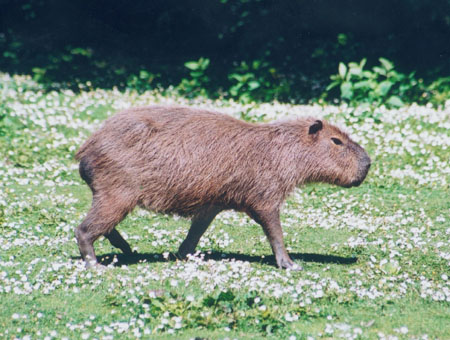
This is a capybara, the largest living rodent and native to South America. I could tell you how it has brown/grey fur and a short, elongated snout like a guinea pig, and long hoofed legs like a piglet, but would the picture you form in your mind really match up with what what the picture shows a capybara to really be like. You may have your own idea, but as they say, a picture is worth a thousand words.
I do believe that one cannot just study words when they are studying history. We may be reading texts and analyzing them, but we are really just seeing the world through the eyes of books during a particular time period. To really transport ourselves to that time, a time so very different from our very own, we need to enlist the help of some visual aids. There was a different structure and way of life in those days, and there is nothing today that can really compare. Taking an image into account can make all the difference. Try describing an oil lamp when all of our lighting today come from incandescent or florescent bulbs. Knowing the difference between these two types of lighting can change a well-lit room into a darkened and more mysterious one. Subtle details like lighting and fashion can really change the meaning of a story if one knows what the things described really look like. If you know what a thing in the text is and how it was used during that time period, you will have a greater understanding of what is going on as well as the connotation that comes along with that item.
Pictures can really help in my understanding of texts from a different time period. Life was so different from how it is today and images from the past can transport me to that time. Before I set out on a text from a different era, I always look up an image. Like a window, it transports me to that time and prepares me for the journey that the text details.
Until next time adventurers,
Emilie
Sunday, March 18, 2012
Following the Leader-An Adventure in Guided Inquiry
I must admit to never having done a guided inquiry before so pardon if I muddle the steps.
Step #1 is What do I Know? Well since I don't know anything about the Restoration and Neoclassic time periods, I will be starting for scratch here. Nothing to fill in this box besides what I maybe can guess from the names of the time periods, but that is it. When in doubt, make a guess. It's called making an inference. I would take what I could gather from root words (Neo=new) and from what I know of other time periods to try and date what would be going on during this time period. So I inferred that something might be being restored during this time period, maybe a ruling family or way of living or something and that maybe the people are taking a new take on classics, which from this time period might be the Greeks and Romans. Also from the literature that I had help picking out, a common theme was class.
When that is done, on to Step #2 What do I want to know? As an ever-curious adventurer, I am always ravenous for more information. I really just enjoy learning as much as I can. Every fact must fit into the tapestry of the time in some way. I want to know what the historical events going on during and around those times were, who were some of the important people, what were some of the common customs, what people wore, how did people define themselves from others (classes, professions, etc.). Basically, I want to learn a whole lot, pretty much everything that I can to define the culture of those times to really hone in on what was going on during that time. I will probably start by just googling the time periods and see what comes up to give myself a basic background in what went on. From there, I would pick out more specific topics to delve deeper into the topics that I want to focus on.
Hobbey-ho!
Emilie
Step #1 is What do I Know? Well since I don't know anything about the Restoration and Neoclassic time periods, I will be starting for scratch here. Nothing to fill in this box besides what I maybe can guess from the names of the time periods, but that is it. When in doubt, make a guess. It's called making an inference. I would take what I could gather from root words (Neo=new) and from what I know of other time periods to try and date what would be going on during this time period. So I inferred that something might be being restored during this time period, maybe a ruling family or way of living or something and that maybe the people are taking a new take on classics, which from this time period might be the Greeks and Romans. Also from the literature that I had help picking out, a common theme was class.
When that is done, on to Step #2 What do I want to know? As an ever-curious adventurer, I am always ravenous for more information. I really just enjoy learning as much as I can. Every fact must fit into the tapestry of the time in some way. I want to know what the historical events going on during and around those times were, who were some of the important people, what were some of the common customs, what people wore, how did people define themselves from others (classes, professions, etc.). Basically, I want to learn a whole lot, pretty much everything that I can to define the culture of those times to really hone in on what was going on during that time. I will probably start by just googling the time periods and see what comes up to give myself a basic background in what went on. From there, I would pick out more specific topics to delve deeper into the topics that I want to focus on.
Hobbey-ho!
Emilie
Monday, March 12, 2012
What Team?!?!!
Out of all the ways to learn, the one that works the best for me is having to learn and explore with others. I might just have one idea, but someone else might have a completely different idea. Texts are able to have different meanings to different people-it's just the nature of wanting to interpret the meaning behind the words that the author chose. I find that getting to know what others interpret a text to mean can help me increase my own understanding of the text.
One day in English class, a few years ago, we were having a discussion on a certain poem. The poem starts out "Christ climbed down from His bare Tree this year." I had thought that the bare tree refereed to a Christmas tree, devoid of decorations, but this turned out not to be the case. Over the course of the discussion, someone mentioned that maybe the bare tree was the cross that Jesus had been hung from. This blew my mind. I would never have thought of that interpretation of that line, but someone else had. By having this discussion, I had a greater understanding of what the author was trying to convey.
By working together as a team to try and uncover the author's purpose in writing, I feel that more can be discovered. Something somebody else thinks can give me a new angle on the meaning. Talking out loud is a more informal way of sharing ideas, and what I think to be the best forum for discussion. Letting the ideas fly allows more interpretations to be brought to light which gives me all of this inspiration to improve my own thoughts on what the author was trying to convey. But without discussing the material with others, none of this would be possible. As one of my favorite bands of all time says "and I'm thinking two is better than one."
Allons-y!
Emilie
One day in English class, a few years ago, we were having a discussion on a certain poem. The poem starts out "Christ climbed down from His bare Tree this year." I had thought that the bare tree refereed to a Christmas tree, devoid of decorations, but this turned out not to be the case. Over the course of the discussion, someone mentioned that maybe the bare tree was the cross that Jesus had been hung from. This blew my mind. I would never have thought of that interpretation of that line, but someone else had. By having this discussion, I had a greater understanding of what the author was trying to convey.
By working together as a team to try and uncover the author's purpose in writing, I feel that more can be discovered. Something somebody else thinks can give me a new angle on the meaning. Talking out loud is a more informal way of sharing ideas, and what I think to be the best forum for discussion. Letting the ideas fly allows more interpretations to be brought to light which gives me all of this inspiration to improve my own thoughts on what the author was trying to convey. But without discussing the material with others, none of this would be possible. As one of my favorite bands of all time says "and I'm thinking two is better than one."
Allons-y!
Emilie
Monday, March 5, 2012
Mental Workout
Even though the brain is not really a muscle, I like to think of it that way. Just like if I wanted some tight abs, my brain needs training too. After all, I can't just wake up one day and decide to run a marathon. I have to prepare and exercise to become fit enough to make it through those endless miles, just like I have to prepare mentally for any sort of test or activity that requires thinking so I don't tire out before the finish line and don't make the grade.
Working out my brain takes a bit of motivation. If I had the choice, I, as well as many of you out there, would love to spend a day relaxing in front of the tv or sleeping. But these things don't build brains, or muscles for that matter. To prepare my brain I need to take an active stance when it come to learning. I can't slack off or wander off into the bottomless pit that is Facebook.
To my training brain, the biggest threat is lack of concentration. I won't be motivated to do the work necessary if my mind is wandering off in la la land or focusing on one of the many distractions that surround me. To combat these distractions and keep my concentration, I need to be sitting somewhere quite and alone so friends cannot come and disrupt my study. I find that when I have to do a large project or paper, this quiet place can really keep me focused on what I need to do. This just applies to when I study on my own. Otherwise, as in a group project, I feel that it is better to talk aloud and not keep strictly silent to better flesh out the direction that we want the project to go.
Out of all of the organs in the body, I think that the brain is the most important one. Without it, none of our other organs would know how to function. Like this, our minds control our capability for learning. If I can concentrate and focus on my learning, not getting distracted, I can learn more efficiently and not waste time procrastinating.
Cheerio!
Emilie
Working out my brain takes a bit of motivation. If I had the choice, I, as well as many of you out there, would love to spend a day relaxing in front of the tv or sleeping. But these things don't build brains, or muscles for that matter. To prepare my brain I need to take an active stance when it come to learning. I can't slack off or wander off into the bottomless pit that is Facebook.
To my training brain, the biggest threat is lack of concentration. I won't be motivated to do the work necessary if my mind is wandering off in la la land or focusing on one of the many distractions that surround me. To combat these distractions and keep my concentration, I need to be sitting somewhere quite and alone so friends cannot come and disrupt my study. I find that when I have to do a large project or paper, this quiet place can really keep me focused on what I need to do. This just applies to when I study on my own. Otherwise, as in a group project, I feel that it is better to talk aloud and not keep strictly silent to better flesh out the direction that we want the project to go.
Out of all of the organs in the body, I think that the brain is the most important one. Without it, none of our other organs would know how to function. Like this, our minds control our capability for learning. If I can concentrate and focus on my learning, not getting distracted, I can learn more efficiently and not waste time procrastinating.
Cheerio!
Emilie
Sunday, February 26, 2012
Before Page One...
Every single topic that I research starts from a single idea.Whenever I want to know something, like most others in this digital age, I will do a quick search on the internet. Before I get into the whole 'nitty gritty' of research I want to have some idea of what is going on to better determine what sort of information would be helpful. This same concept goes with choosing out literature. I want to know before I dive in and commit to taking a book out of the library, with the added responsibility of lugging it around with care, I always want to see what I am getting myself into. I don't want to go through the hassle of checking out a book that I will never read. I want to know what I have in store and not end up reading something that does not pique my interest. But this post isn't going to be about what I love in a book--maybe I'll save that for another time.
Background knowledge is so important to me when learning about pretty much everything. I feel that most things that we learn in school are just one small part in a much larger scale of things. To better appreciate and understand the importance and relevance of what we are learning, I need to know more. I want to know what was going on in the world during that time period, what the life of the author was like, and what other events influenced and were influenced by this. Maybe it's just the child in me, but I am always curious and on the lookout for more information to satiate my hunger for more.
I can never tell if I am going to like a book or not, just by the cover. That would be biased against all the potentially wonderful books that are hidden behind poor cover art. I try to learn more about the book: the plot line, other works by that author, and if it had positive reviews. There is just so much information that goes into learning more information! The point being, if you want to learn about something, you have to research more than just the topic--there are so many lines of other topics connecting to that one topic you are researching. Like a spider diagram, there are so many parts and angles to a topic, that background research is the only way to fully grasp the meaning and significance of that one topic. After all, knowledge is power.
Shiver-me-timbers!
Emilie
Background knowledge is so important to me when learning about pretty much everything. I feel that most things that we learn in school are just one small part in a much larger scale of things. To better appreciate and understand the importance and relevance of what we are learning, I need to know more. I want to know what was going on in the world during that time period, what the life of the author was like, and what other events influenced and were influenced by this. Maybe it's just the child in me, but I am always curious and on the lookout for more information to satiate my hunger for more.
I can never tell if I am going to like a book or not, just by the cover. That would be biased against all the potentially wonderful books that are hidden behind poor cover art. I try to learn more about the book: the plot line, other works by that author, and if it had positive reviews. There is just so much information that goes into learning more information! The point being, if you want to learn about something, you have to research more than just the topic--there are so many lines of other topics connecting to that one topic you are researching. Like a spider diagram, there are so many parts and angles to a topic, that background research is the only way to fully grasp the meaning and significance of that one topic. After all, knowledge is power.
Shiver-me-timbers!
Emilie
Tuesday, February 21, 2012
Post #1.5 "Thinking about Thinking"
So this is my first reflection on not really what I've learned but how I've learned it. I haven't really had to do this before--thinking about how I think. I guess I've just never thought about it before. I've just taken in what there was, not thinking or knowing if there was a different or better way of doing things. But I guess there is more than one way to skin a cat, and also more than one way to learn.
This class has given me a lot of freedom in the choices I get to make about what I read and how I assess myself on it. I am not restricted by a certain book that the whole class must read together, just restricted by the time period when the text was written. It scares me to have so much power and influence over what I get to learn and what I learn about. I've warmed up to this way of learning slowly. The freedom that I now have allows me to delve into topics that interest me, and I see that as both a good and a bad thing.
First the good. I don't have to read endless texts analyzing the same topic over and over again, unless I am really interested in that topic. Then I wouldn't agonize over reading a book I hated and not want to understand it, in pure contempt and rebellion. I get to learn about what I learn about. With the independent texts, my favorite concept does not have to be shared by anyone else in the class. It is more of an independent learning experience, than a whole class one.
Next, onto the bad. By only selecting texts that I think may be interesting to me, I think that I might miss out on a really good text that I would really enjoy. Not being a master of literature or having a teacher's expertise on choosing out texts could make me miss important sources. The sheer freedom of being able to choose whatever I want is a little intimidating to me. I feel that I need a bit more structure, otherwise I will be totally and utterly lost. I need some direction for me to do the best work possible. The individualization of this process also has me a bit worried. I enjoy discussing things out loud and getting the ideas of other people to better understand a text, and I don't know how this will be possible if everyone is reading different texts.
I am willing to try this different way of learning, even though I am a bit nervous. I think that too many restrictions can damper my creativity, and this different way of learning might be a solution to this. I hope to learn more about what way I learn the best. I know that I learn better with pictures and diagrams, as well as verbally discussing and dissecting material. But who knows what the next section will teach me about myself. The better I understand myself and how I learn, the more effectively I can learn new things.
Tally-ho!
Emilie
This class has given me a lot of freedom in the choices I get to make about what I read and how I assess myself on it. I am not restricted by a certain book that the whole class must read together, just restricted by the time period when the text was written. It scares me to have so much power and influence over what I get to learn and what I learn about. I've warmed up to this way of learning slowly. The freedom that I now have allows me to delve into topics that interest me, and I see that as both a good and a bad thing.
First the good. I don't have to read endless texts analyzing the same topic over and over again, unless I am really interested in that topic. Then I wouldn't agonize over reading a book I hated and not want to understand it, in pure contempt and rebellion. I get to learn about what I learn about. With the independent texts, my favorite concept does not have to be shared by anyone else in the class. It is more of an independent learning experience, than a whole class one.
Next, onto the bad. By only selecting texts that I think may be interesting to me, I think that I might miss out on a really good text that I would really enjoy. Not being a master of literature or having a teacher's expertise on choosing out texts could make me miss important sources. The sheer freedom of being able to choose whatever I want is a little intimidating to me. I feel that I need a bit more structure, otherwise I will be totally and utterly lost. I need some direction for me to do the best work possible. The individualization of this process also has me a bit worried. I enjoy discussing things out loud and getting the ideas of other people to better understand a text, and I don't know how this will be possible if everyone is reading different texts.
I am willing to try this different way of learning, even though I am a bit nervous. I think that too many restrictions can damper my creativity, and this different way of learning might be a solution to this. I hope to learn more about what way I learn the best. I know that I learn better with pictures and diagrams, as well as verbally discussing and dissecting material. But who knows what the next section will teach me about myself. The better I understand myself and how I learn, the more effectively I can learn new things.
Tally-ho!
Emilie
Tuesday, February 7, 2012
So why pirates?
I will answer that question but let me get some things out of the way first. Hello everyone! This is blog post number one. The first, the original, the ancestor of all posts to come, so forgive it for not being the best thing you've ever read-it's still a baby.
But now back to the pirates. At first, I really had no idea what I was going to call this new blog. So I googled a random word generator and bam! Here we are today. Picaroon is just another, obscure word for a pirate or pirate ship. Pirates, the brave marauders of the open seas, were men (and sometimes women) of the sea. What better way to add some spice and spunk to my blog then with a jolly title? It was just the luck of the draw but not a total disaster of a title.
A little blurp about me before I end: I, Emilie, have always disliked spitballs, bees, and brussel sprouts. I am a secretive band nerd and really want to be able to juggle and climb up the Eiffel Tower one day.
But now back to the pirates. At first, I really had no idea what I was going to call this new blog. So I googled a random word generator and bam! Here we are today. Picaroon is just another, obscure word for a pirate or pirate ship. Pirates, the brave marauders of the open seas, were men (and sometimes women) of the sea. What better way to add some spice and spunk to my blog then with a jolly title? It was just the luck of the draw but not a total disaster of a title.
A little blurp about me before I end: I, Emilie, have always disliked spitballs, bees, and brussel sprouts. I am a secretive band nerd and really want to be able to juggle and climb up the Eiffel Tower one day.
Subscribe to:
Comments (Atom)